

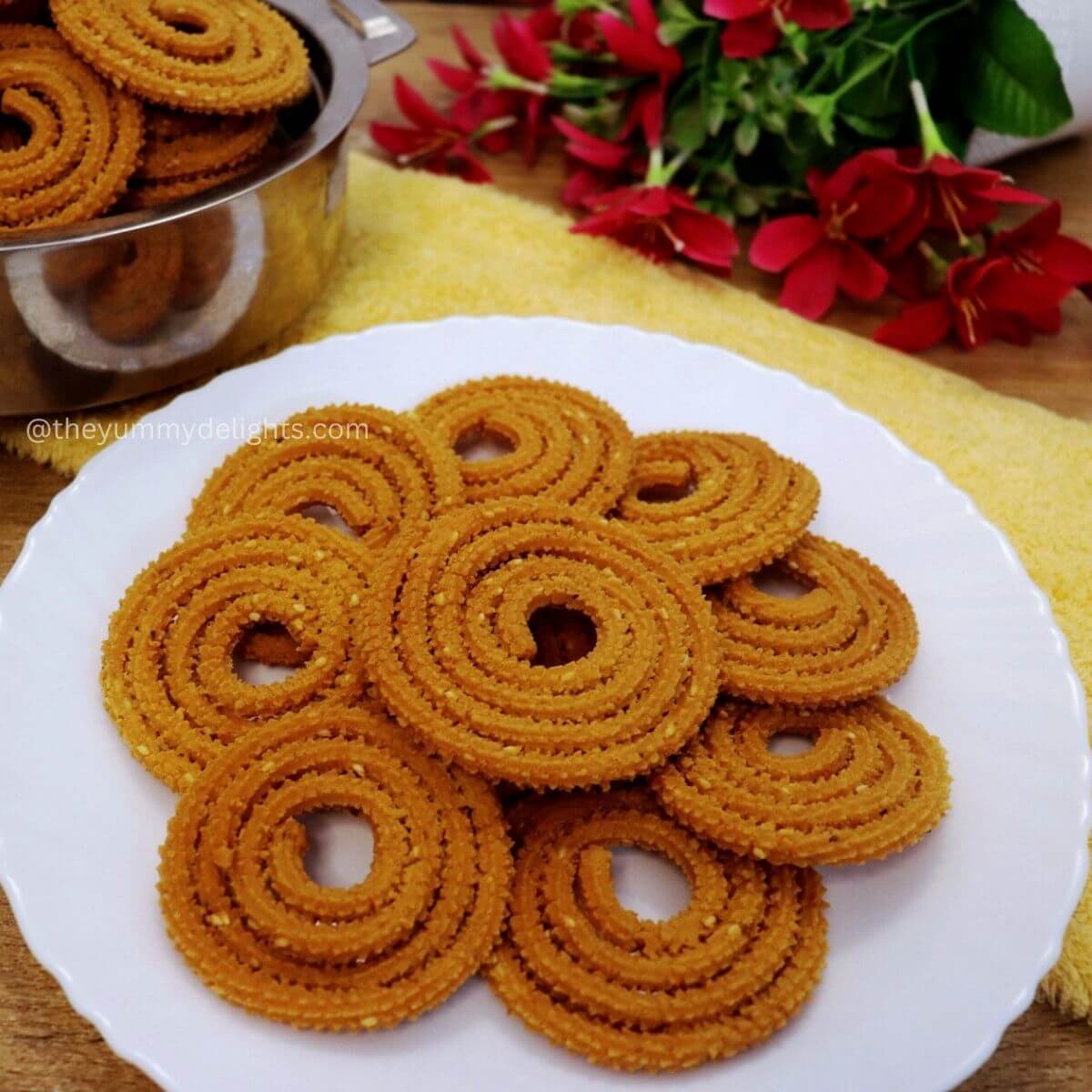
Maharashtrian chakli recipe, also known as bhajani chakli, is a crispy, savoury spiral-shaped snack made with roasted multigrain flour. My mom makes traditional bhajani chakli every Diwali, but I use a quick homemade bhajani for chakli so I can make it from start to finish in about an hour. I've also shared some tips for shaping and frying chakli without breaking, so you get crispy, perfectly shaped chakli.
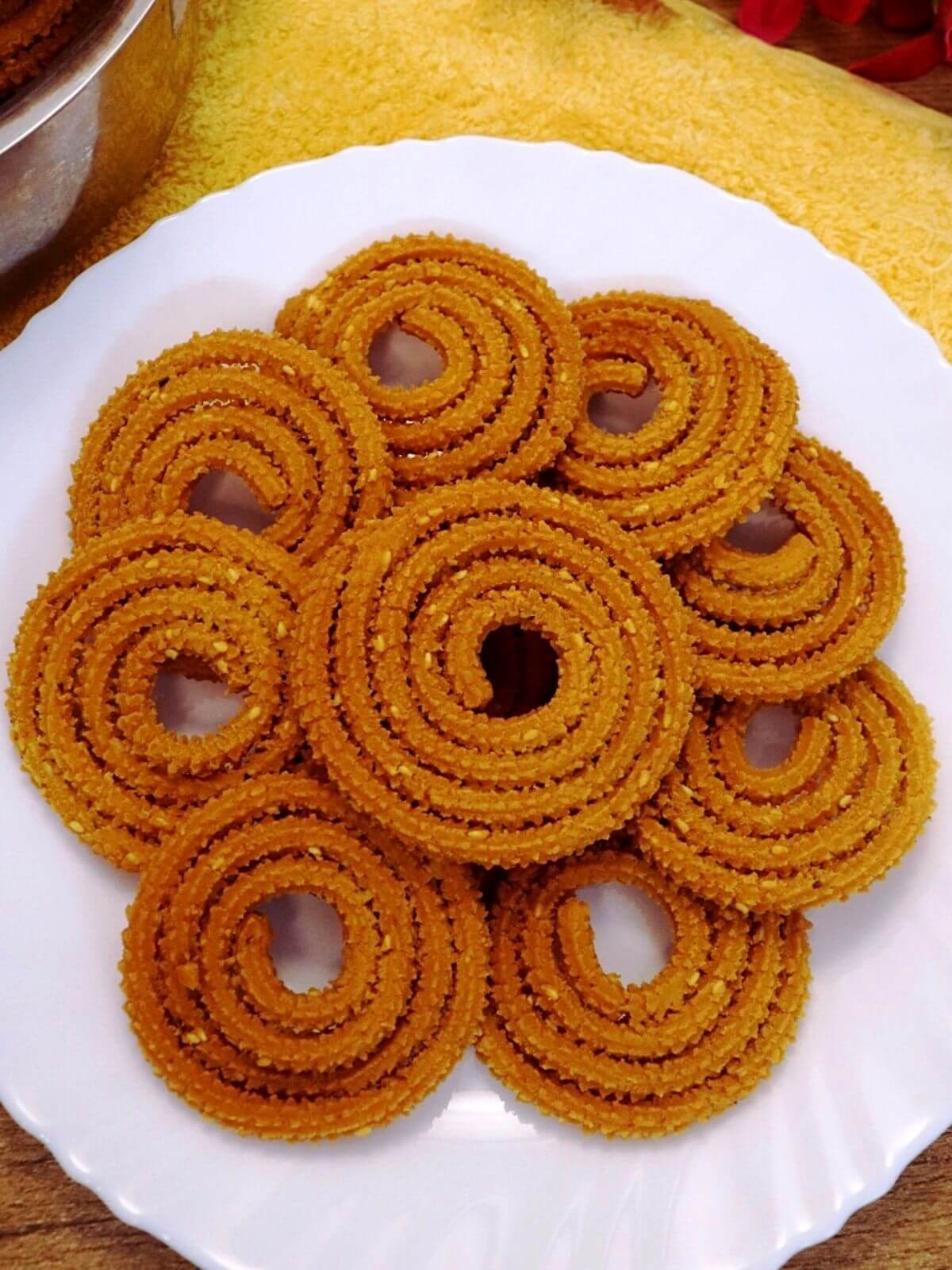
Traditionally, the Maharashtrian chakli recipe uses bhajani flour prepared ahead by roasting the grains and getting them ground at a flour mill. With my easy recipe, you can make the bhajani quickly at home and use it right away, so there's no need to prepare the chakli flour days in advance, which saves a lot of time.
I like to serve these bhajani chakli along with Pakatale rava ladoo, Shankarpali, and Nevri for our Diwali platter. Its crispy, savoury flavour perfectly balances the festive sweets. You might also like my Instant Mawa, Besan Ladoo, and Peanut Ladoo for your Diwali celebrations.
What is Bhajani?
Bhajani is a roasted flour blend traditionally used to make Maharashtrian chakli. The word bhajani comes from the Marathi word bhajane, meaning to roast. Traditionally, rice, urad dal, moong dal, and chana dal are roasted separately with spices, ground into a fine flour, and often prepared ahead of time. The ingredients can vary from one family to another.
My quick chakli bhajani recipe uses rice flour, urad dal, and split gram (putane or split chana) and spices. Instead of chana dal, I use split gram (putane) because split gram gives the chakli a lighter, crispier texture.
What is Chakli?
Chakli is a crunchy, savoury, spiral-shaped, deep-fried Indian snack made from rice and lentil flour. In Maharashtra, bhajani chakli is traditionally made with roasted grains, lentils, and spices, mostly during Diwali, Ganesh Chaturthi, and other festivals.
Quick Look: Maharashtrian Chakli Recipe
- Prep Time: 20 minutes
- Cook Time: 20 minutes
- Total Time: 40 minutes
- Servings: 35
- Calories: ~164 kcal per serving (based on nutrition panel)
- Ingredients: Rice flour, urad dal, split gram, sesame seeds, cumin, and spices.
- Flavour: Savoury and mildly spicy.
- Texture: Light, crispy, and crunchy.
- Difficulty: Medium
Jump to:
Chakli Bhajani Ingredients
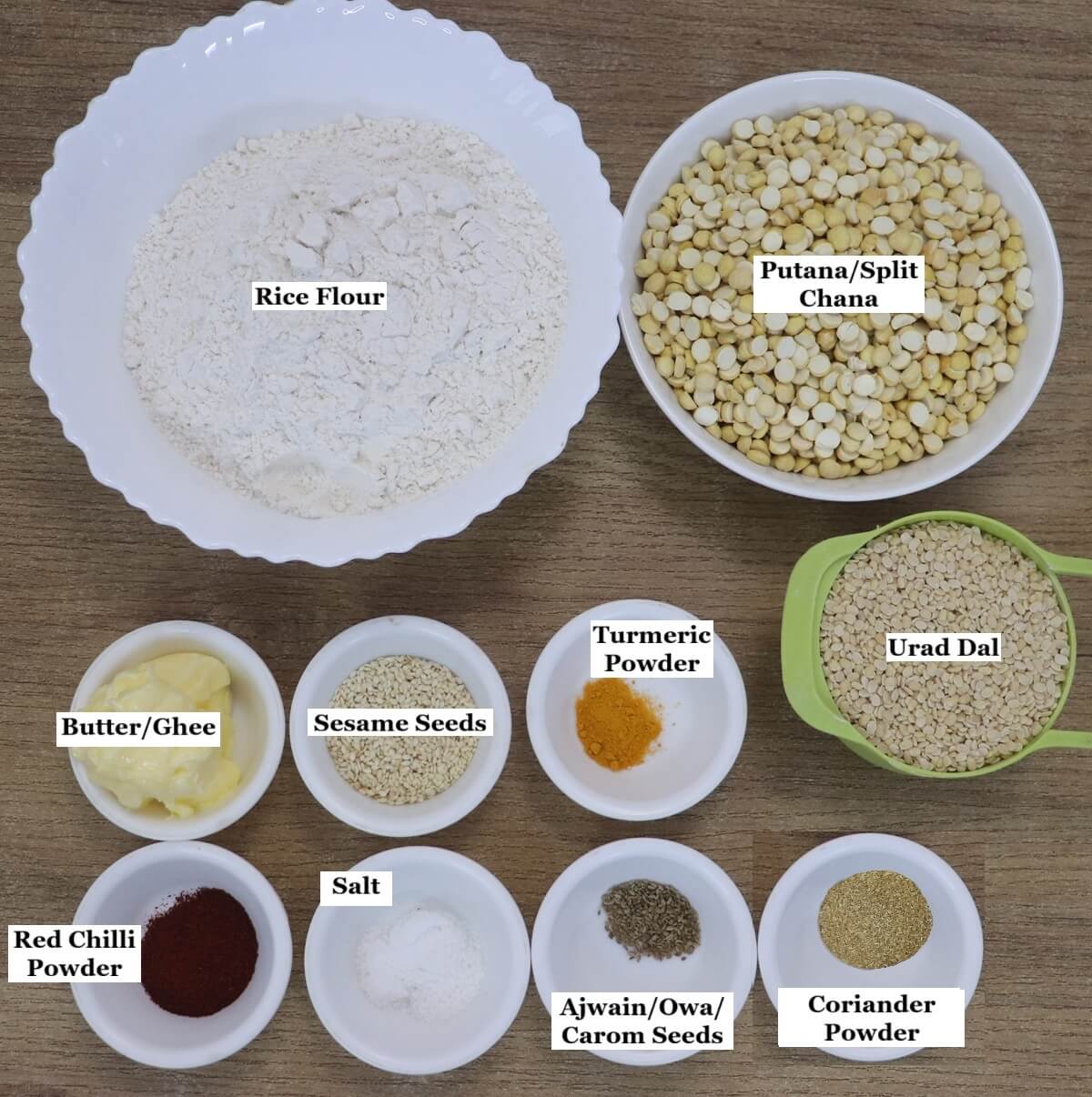
See the recipe card at the end of the post for full ingredients, quantities, and a printable version.
- Rice flour: Rice flour is easily available in stores. However, you can also prepare rice flour at home. Clean rice as we did with urad dal in the recipe. Then roast, cool, and grind it to a fine powder.
- Urad dal/black gram dal (skinless): You can make it without it, but you will miss the authentic Maharashtrian flavour.
- Split gram (dalia/putana): Do not confuse this with chana dal. Split gram is also called split chana, putana, or dalia. It gives the chakli a light, crispy texture.
- Spice powders: spicy red chilli powder, turmeric, coriander powder, and cumin powder.
- Butter: I use butter as the moyan in this recipe because it gives the chakli a delicious flavour and helps keep it crisp. You can also use ghee or oil if you prefer. While measuring butter, make sure it is in a semi-solid state. Check the ingredient image.
How to make Maharashtrian Chakli Recipe
Prepare the Bhajani Flour
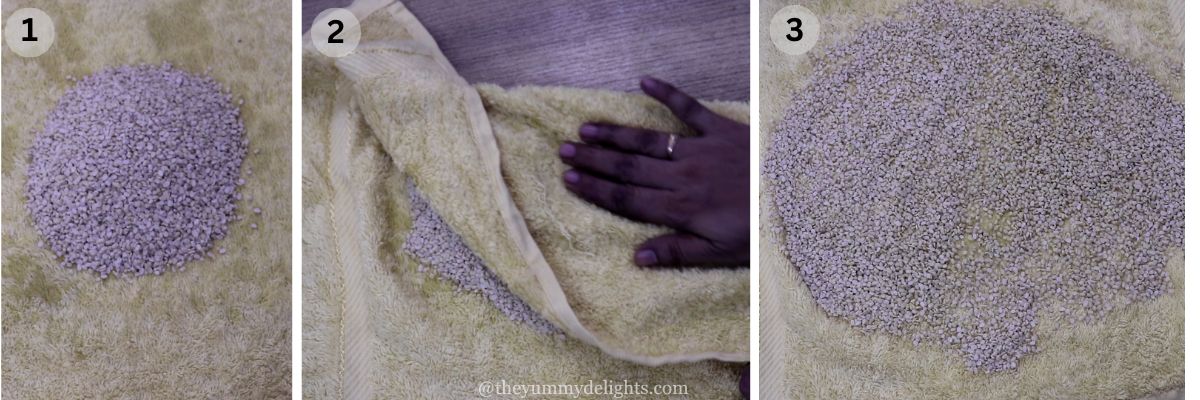
1) Take urad dal/black gram dal. To clean the urad dal, dampen a clean cotton cloth or kitchen towel with water. Gently rub the urad dal against the cloth to remove any dirt (images 1, 2, & 3).
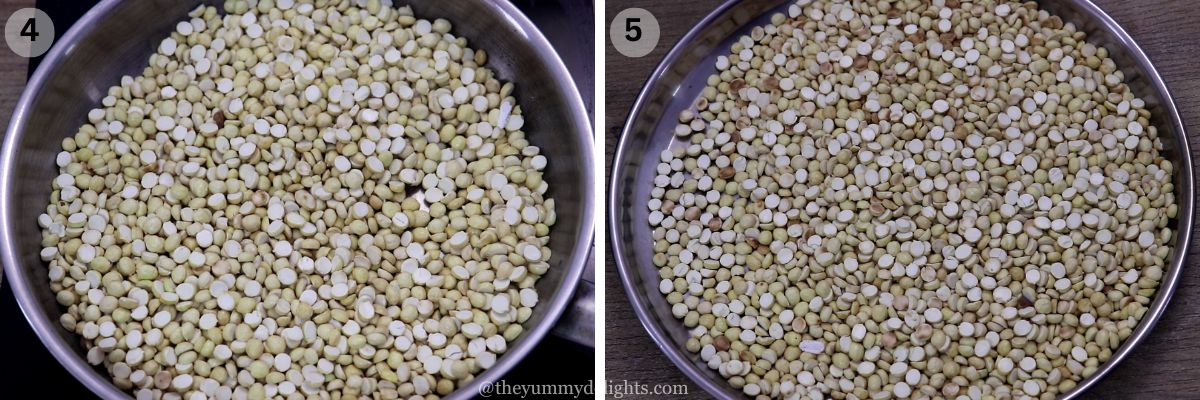
2) Dry roast chana/putana in a heavy-bottomed pan over low-medium heat until fragrant. Avoid browning them (images 4 & 5). Transfer the roasted chana/putana to a plate and let it cool completely.
3) Next, add urad dal to the same pan (image 6) and dry roast it over low-medium heat until fragrant. Remove the urad dal as soon as it starts to change colour slightly. Transfer it to the plate with the chana/putana and let it cool completely (image 7). Do not roast the urad dal until golden.
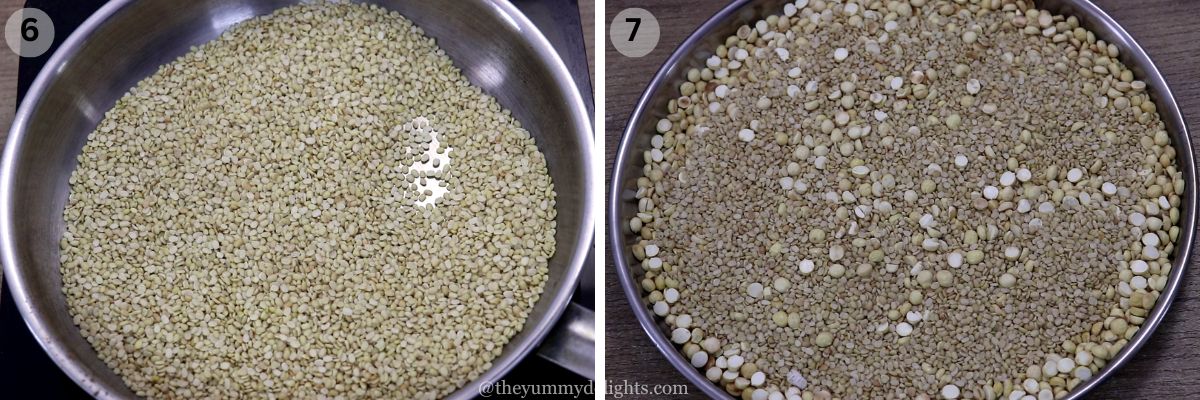
4) To make bhajani flour, you can either have the bhajani ingredients ground at a mill or grind them yourself in a mixer. Don't fill the mixer jar more than a quarter (¼th) full with the ingredients (image 8). Grind the ingredients into a fine powder (image 9).
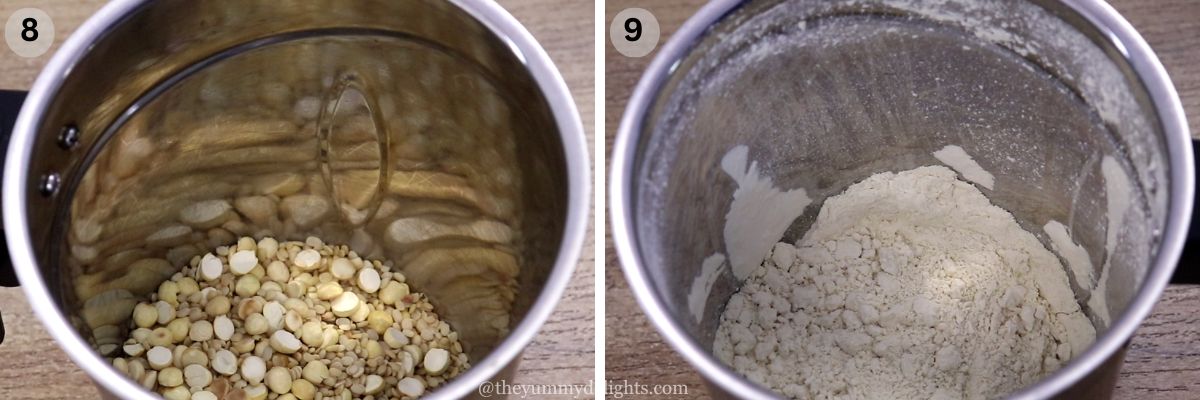
5) Sift the ground flour to get rid of any coarse particles (image 10). Then, do the same with the rest of the roasted bhajani ingredients (image 11).
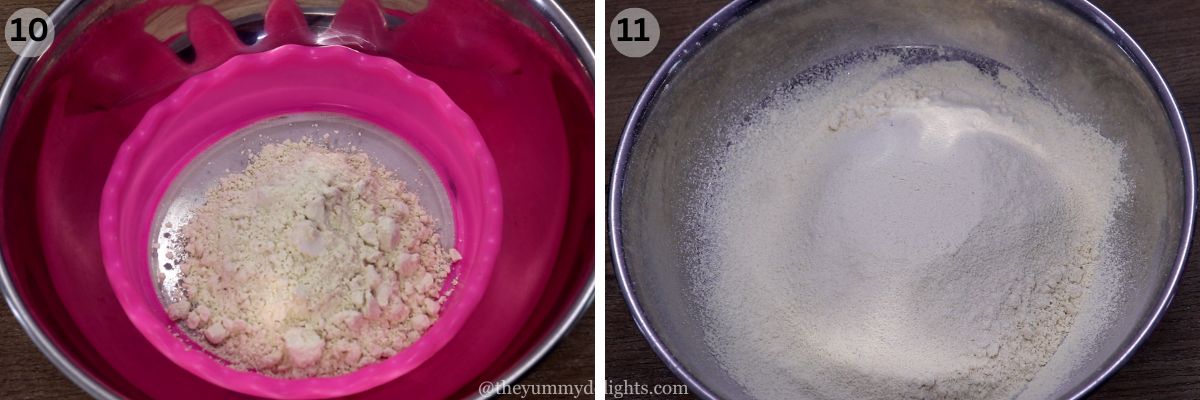
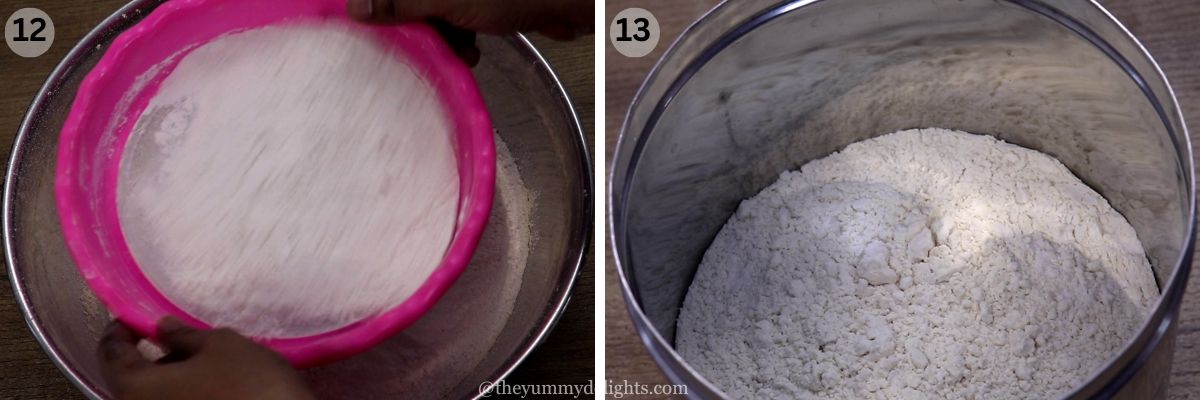
6) Sift rice flour and combine it with the other ingredients (image 12). Homemade bhajani flour is ready (image 13). Store the bhajani flour in an airtight container for up to 3 months.
Make the Chakli Dough
7) To make the dough, combine 4 cups of bhajani flour, salt, spicy red chilli powder, sesame seeds, carom seeds (ajwain), turmeric, coriander powder, and cumin powder in a big bowl/plate (images 14 & 15). Mix gently with a spoon. You can add asafoetida for authentic bhajani flavour.
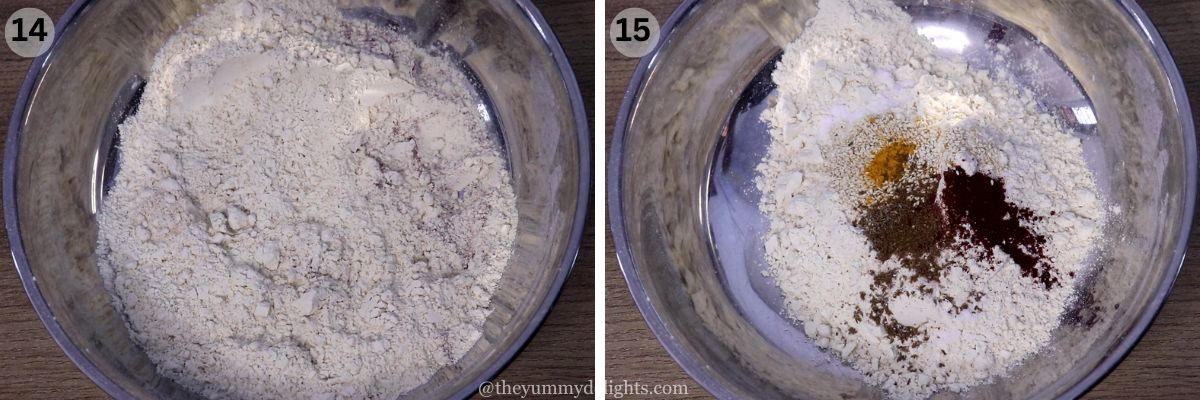
8) Heat butter in a tadka pan. Add hot butter (called moyen or mohan) to the bhajani flour (image 16). Combine with a spoon first. Be careful, as the chakli mixture will be hot. Now slowly rub the butter into the flour with your fingers for 3-4 minutes. This process will make the bhajani chakli crispy. Press the flour firmly with your hands to check if it holds together (see image 17). If it doesn't, then add 1 teaspoon of hot butter and combine.
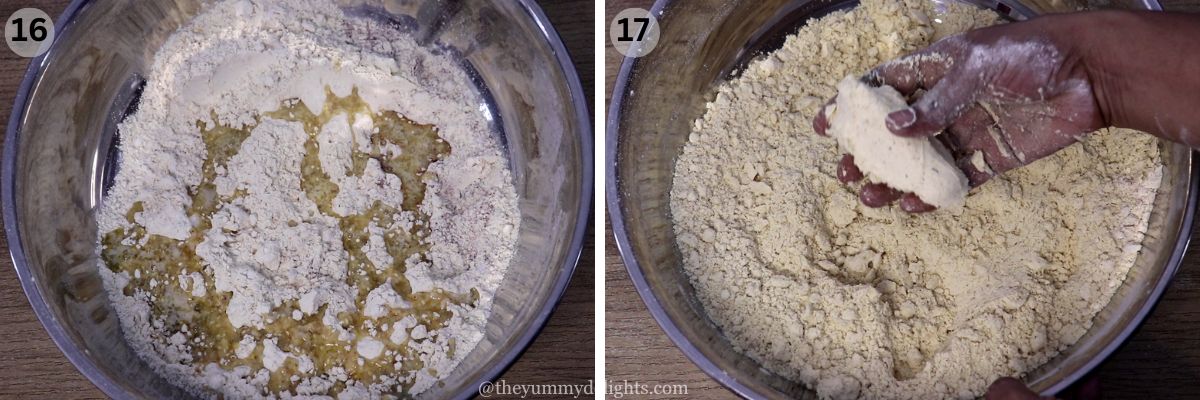
9) Add hot water gradually, starting with a small amount and mixing with a spoon. Then add more hot water in batches and combine. Your bhajani dough will look like this (image 18).
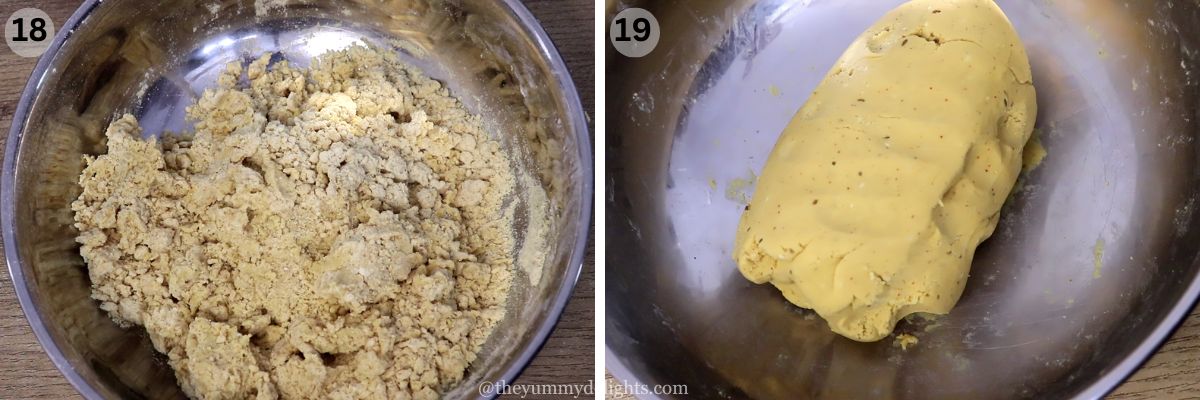
10) If the heat is tolerable, knead the dough with your hands until it forms smooth, crack-free, and firm dough (image 19). If the dough is too hot to handle, cover it and let it rest for 5 minutes before kneading.
11) Gradually add 1-2 teaspoons of water at a time while kneading. Ensure the chakli dough is smooth and stiff. Let it rest for 15 minutes. Meanwhile, prep the chakli maker and grease it with oil (only one time).
Shape the Chakli
12) Heat enough oil in a heavy-bottomed pot/pan over medium heat to fry bhajani chakli.
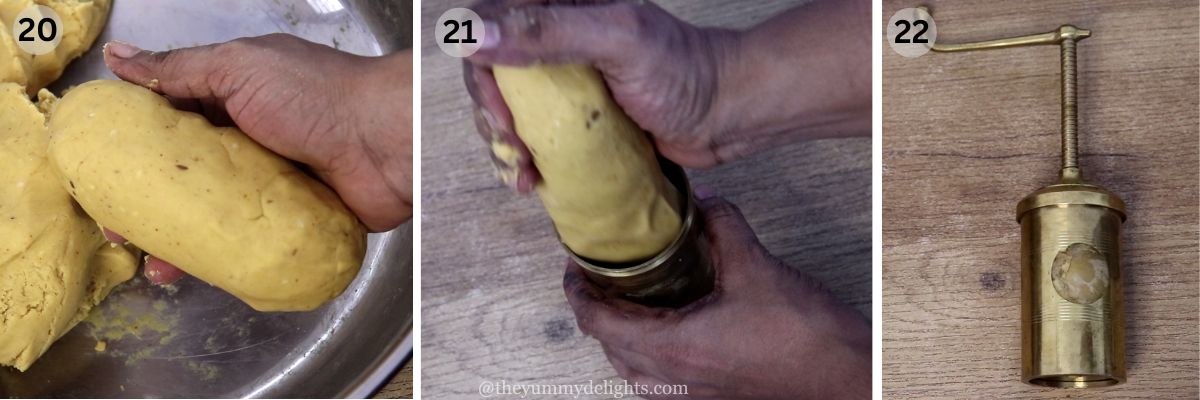
13) Take a small piece of the dough. Cover the remaining dough. Roll it into a cylindrical shape with your hands (image 20). Then, insert it into the chakli maker (image 21) and close it (image 22). Check out the video for more details.
14) Make a spiral shape with 3-4 rounds (images 23 & 24). Join the end to the closest spiral (image 25). If your chakli dough is right, it will not break while shaping, and you will get those beautiful spikes.
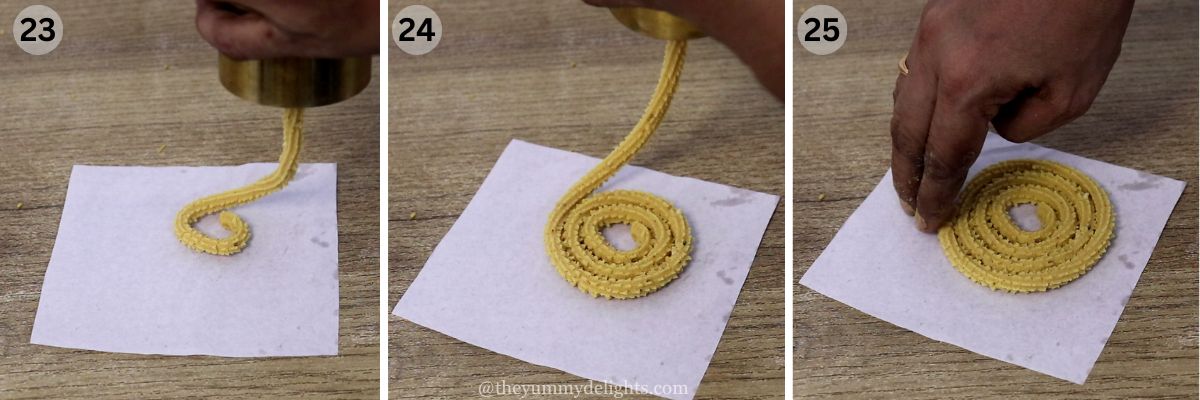
15) If your spiral shape breaks and you cannot make it, sprinkle some water on the dough, knead it again, and start making it.
16) If you are making chakli for the first time, I suggest making only one and frying it. Let it cool down and taste it. If it is too hard, add more butter to the dough and knead it again. If it is soft/not crispy or absorbs oil means you have added more water. Add more rice flour to the dough and knead.
17) If the chakli breaks in oil, it means there is too much butter in the dough. Add more rice flour to the remaining dough and knead it.
Fry the Chakli
18) To fry, heat oil over medium heat. Drop a small piece of dough into the oil. If it rises too quickly and browns, the oil is too hot; if it rises slowly, the oil is not hot enough.
19) Maintain the oil at the right temperature while frying. If you're a beginner, gently place it on a slotted spoon (image 26), then slide the spoon to release it into the oil. (images 27 & 28).
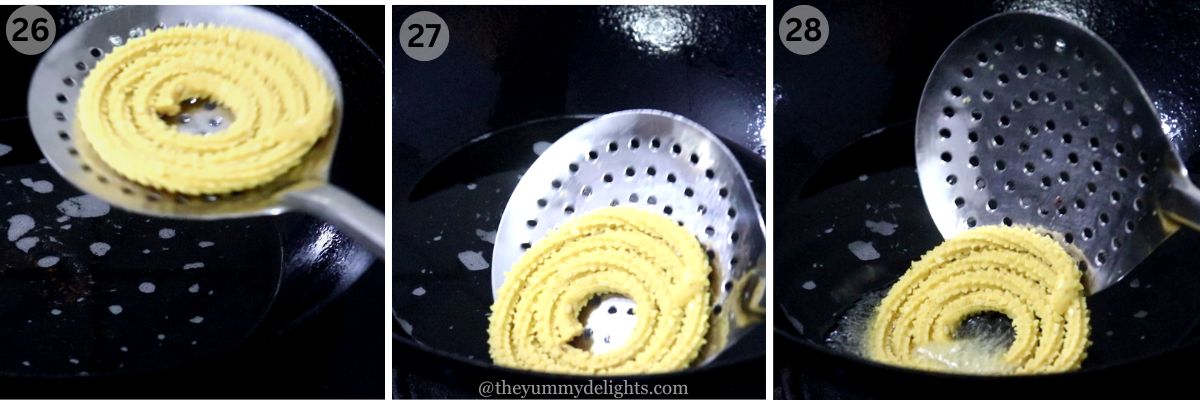
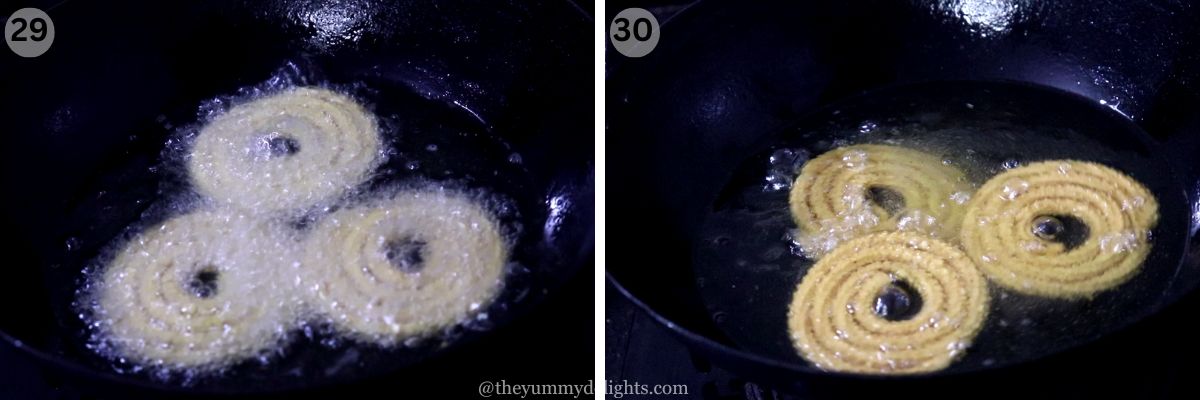
20) Let it sit undisturbed for a minute or until the shape has set. Then, carefully flip it over and continue frying. Initially, when frying chakli, the hot oil will produce a lot of bubbles (image 29). As the chakli cooks, the bubbling will subside (image 30).
21) Fry only 2-3 at a time, depending on the size of the pan or kadhai. Avoid overcrowding the pan. Once the bubbling has significantly reduced, the chakli is golden brown and crispy. Remove it and set aside on a big strainer or paper towel-lined plate to remove excess oil (images 31 & 32). Then fry the next batch.
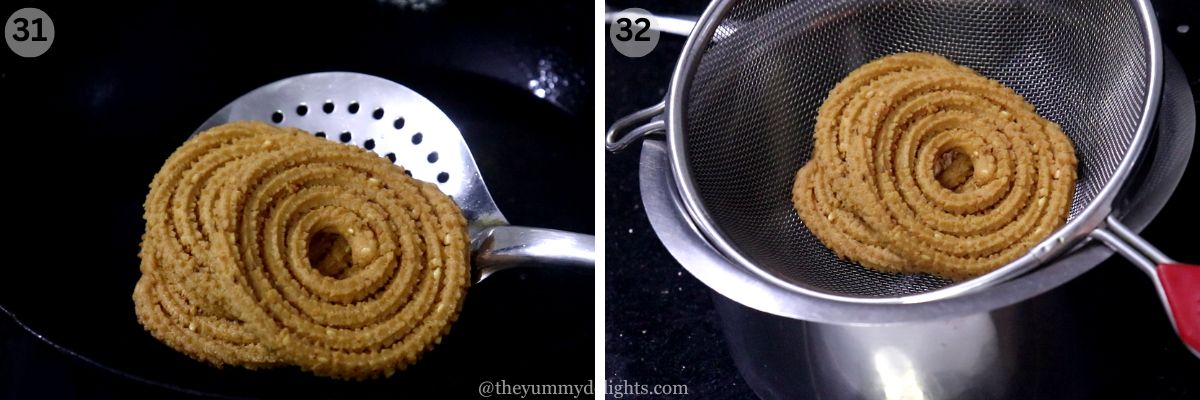
21) Once cooled, you'll notice the chakli is extra crispy and light, with a beautiful hollow centre. Try this Maharashtrian chakli recipe and share in the comments how it turned out.
Storage: Once cooled, store them in an airtight container. They will remain fresh for up to 15 days.
Equipment Needed
The Chakli Maker with a star-shaped disc is an important tool used to create the spiral shape and distinctive star-shaped spike design. You can easily purchase it at your local kitchenware shop or online marketplace.
Tips for Crispy Maharashtrian Chakli
- Get the dough consistency right: The dough should be smooth, crack-free, and firm enough to hold its shape. If it is too hard, the chakli can break while pressing. If it is too soft, it may absorb oil and lose its crispiness.
- Don't add too much water: Add water gradually while kneading the dough. A soft dough may make the chakli absorb more oil.
- Check the oil temperature: Drop a small piece of dough into the oil. It should rise gradually. If it rises immediately and browns quickly, the oil is too hot. If it takes a long time to rise, the oil is not hot enough.
- Don't overcrowd the pan: Fry only 2-3 chakli at a time, depending on the size of your pan. Overcrowding lowers the oil temperature and can make the chakli oily.
- Let the chakli cool completely: Chakli becomes crispier as it cools. Do not store it while it is still warm.
Recipe FAQs
If it breaks while shaping, it means the dough is dry. Sprinkle some water on the dough, knead it again, and start making it. Do not add too much water.
When stored in an airtight container, it stays fresh for 2 weeks. I have used butter in the recipe. But if you make it with oil, it will stay fresh for a month at room temperature.
Yes, baking is a healthier alternative. Preheat the oven to 180°C (350°F) for 15 minutes. Bake it for 7 minutes, then flip it and bake for another 10 minutes or until brown. It took a total of 17 minutes to bake. But every oven is different, so keep an eye on it after 15 minutes.
Bhajani is made by rinsing, drying, and roasting a mix of rice and lentils over 2-3 days, then grinding it into a fine powder at a mill. This ground flour is then mixed with spices, kneaded into a dough, shaped into spirals, and deep-fried. The process takes time, but this homemade bhajani chakli flour is better than the store-bought ones. I have shared a quick bhajani recipe, ready in 30 minutes, in this post.

Recipe Card
Maharashtrian Chakli Recipe
Video

Equipment
- 1 Heavy bottom pan
- 1 Mixing bowl
- 1 Chakli Maker
Ingredients
To make Bhajani Flour
- 3 cups of rice flour
- 1 cup Urad dal/black gram dal, skinless
- 2 cups Split gram lentils/chana/putana/dalya Not chana dal
To make Bhajani Chakli
- 4 cups of the prepared bhajani flour
- salt to taste
- 1.5 teaspoon spicy red chili powder
- 3 teaspoon sesame seeds
- ¼ teaspoon carom seeds ajwain
- 1 teaspoon coriander powder
- ¼ teaspoon turmeric
- ½ teaspoon cumin powder
- 3 tablespoon butter, semi-solid form (substitute: Ghee/Oil)
Instructions
Prepare the bhajani flour (chakli flour)
- To clean the urad dal, dampen a clean cotton cloth or kitchen towel with water. Gently rub the urad dal against the cloth to remove any dirt.1 cup Urad dal/black gram dal, skinless
- Dry roast chana/putana in a heavy-bottomed pan over low-medium heat until fragrant. Avoid browning them. Transfer the roasted chana/putana to a plate and let it cool completely.2 cups Split gram lentils/chana/putana/dalya
- Next, add urad dal to the same pan and dry roast it over low-medium heat until fragrant. Remove the urad dal as soon as it starts to change color slightly. Transfer it to the plate with the chana/putana and let them cool completely.
- To make chakli bhajani, you can either have the bhajani ingredients ground at a mill or grind them yourself in a mixer. To grind it at home in a mixer, don't fill the mixer jar more than a quarter (¼th) full with the bhajani ingredients. Grind the ingredients into a fine powder.
- Sift the ground flour to get rid of any coarse particles. Then, do the same with the rest of the roasted bhajani ingredients.
- Sift the rice flour and combine it with the other ingredients. Bhajani flour is ready. Store the bhajani flour in an airtight container for up to 3 months.3 cups of rice flour
Make the Chakli Dough
- To make Chakli, combine 4 cups of bhajani flour, salt, red chili powder, sesame seeds, coriander powder, carom seeds (ajwain), turmeric, and cumin powder in a big bowl/plate. Mix gently with a spoon.4 cups of the prepared bhajani flour, salt to taste, 1.5 tsp spicy red chili powder, 3 tsp sesame seeds, ¼ tsp carom seeds, 1 tsp coriander powder, ¼ tsp turmeric, ½ tsp cumin powder
- Heat butter in a tadka pan. Add hot butter (called moyen or mohan) to the chakli flour. Combine with a spoon first. Be careful, as the mixture will be hot. Now slowly rub the butter into the flour with your fingers for 3-4 minutes. This process will make the chakli crispy.3 tbsp butter, semi-solid form (substitute: Ghee/Oil)
- Press the flour firmly with your hands to check if it holds together. If not holding its shape, add a little butter and check.
- Add hot water gradually, starting with a small amount and mixing with a spoon. Then add more hot water in batches and mix.
- If the heat is tolerable, knead the dough with your hands until it forms a smooth, crack-free, and firm dough. If the dough is too hot to handle, cover it and let it rest for 5 minutes before kneading.
- Gradually add 1-2 teaspoons of water at a time while kneading the chakli dough. Ensure the dough is smooth and stiff. Taste the dough and adjust salt or chilli powder to taste. Let it rest for 15 minutes. Meanwhile, prep the chakli maker and grease it with oil (only once before starting).
Shaping Maharashtrian Chakli
- Heat enough oil in a heavy-bottomed pot/pan over medium heat.
- Take a small piece of chakli dough. Cover the remaining dough. Roll it into a cylindrical shape with your hands. Then, insert it into the chakli maker. Close it. Check out the video for more details.
- Make a spiral shape with 3-4 rounds. Join the end of it to the closest spiral. If your dough is right, the chakli will not break, and you'll get those beautiful spikes.
- If your spiral shape breaks, sprinkle some water on the chakli dough, knead it again, and start making it.
- If you are making chakli for the first time, I suggest making only one and frying it. Let it cool down and taste it. If it is too hard, add more butter to the dough and knead it again. If it is soft/not crispy or absorbs oil means you have added more water. Add more bahjani flour or rice flour to the dough and knead.
- If the chakli breaks in oil, it means there is too much butter in the dough. Add more rice flour to the remaining dough and knead it.
Fry the Chakli
- To fry chakli, heat oil over medium heat. Avoid lowering the heat throughout the frying process. If you're a beginner, gently place the chakli on a slotted spoon, then slide the spoon to release it into the hot oil.
- Let it sit undisturbed for a minute or until the spiral shape has set. Then, carefully flip the chakli over and continue frying. Initially, when frying chakli, the hot oil will produce a lot of bubbles. As the chakli cooks, the bubbling will subside.
- Fry only 2-3 at a time, depending on the size of the pan. Avoid overcrowding the pan. Once the bubbling has significantly reduced, the chakli is done. Remove and set aside on a big strainer or paper towel-lined plate to remove excess oil. Then fry the next batch.
- Once cooled, you'll notice the chakli is extra crispy and light, with a beautiful hollow center. Store them in an airtight container. It will remain fresh for up to 15 days.
Notes
- If chakli breaks while shaping, the dough is dry. Sprinkle a little water, knead again.
- If it is hard after frying, add more butter and knead.
- If chakli is too soft/absorbs oil, then the dough has extra water. Add rice flour or bhajani flour, and knead.
- Chakli breaks in oil. If too much butter is added to the dough, add rice flour and knead.
- Chakli absorbs oil. Check the oil temperature. Drop a small dough piece. If it rises slowly, the oil is not hot enough. If it rises too fast & browns, the oil is too hot.
- Add a pinch of asafoetida for flavour (optional).
- Knead the chakli dough smooth. It should be soft but firm.
- Don't overcrowd while frying. Cool completely before storing chakli in an airtight jar.
Nutrition
Nutrition information is automatically calculated, so should only be used as an approximation.
More Maharashtrian Recipes You Might Like
- Maharashtrian Chicken Sukka
- Maharashtrian Sabudana Khichdi
- Kolhapuri Misal Pav
- Maharashtrian Puran Poli
- Kolhapuri Chicken Curry

Preeti
This is my favorite bhajani chakli recipe. I make them every Diwali, and my celebration is incomplete without them. They come out perfectly crispy and delicious every time. Try this recipe this Diwali, you will love it.
roxane
This was such a useful article, I’m sharing it.